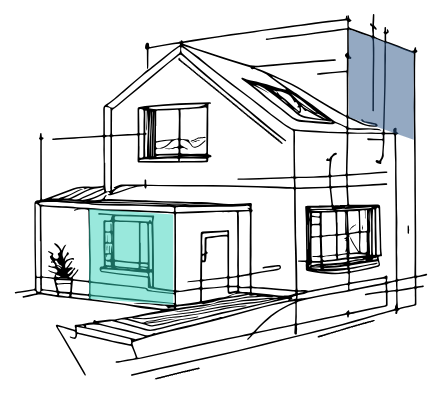
Planning an addition, a bedroom over the garage, or a basement suite on a home with a septic system? You’ll need septic approval before anyone can pull a building permit. Here’s how to handle it yourself, then bring us in to build.
Who Handles Septic Permits in Hamilton County?
In most of Tennessee, the state (TDEC) issues septic permits. Hamilton County is one of nine “contract counties” that run their own program under state rules. Here, septic permits come from the Hamilton County Division of Groundwater Protection, part of Development Services. They aren’t issued by your city or town.
That applies in unincorporated Hamilton County, Signal Mountain, Lookout Mountain, Walden, Red Bank and East Ridge. Your town still issues the building permit, but only once sanitation is covered: a sewer tap from the Water & Wastewater Treatment Authority (WWTA) or a septic approval from Groundwater Protection.
Hamilton County Groundwater Protection
1250 Market Street, Suite 3046, Chattanooga, TN 37402
Phone: 423-209-7876 | Email: gwp@hamiltontn.gov
Hours: Monday to Friday, 8:00 a.m. to 4:00 p.m.
Apply online: Hamilton County Development Services (all septic applications go through the county’s online portal)
Much of the City of Chattanooga, Red Bank and East Ridge is on public sewer. Septic is common on the mountains, in the outer parts of the county and on larger lots. Not sure? Call WWTA at 423-209-7842.
Why Bedrooms Are the Big Issue
A septic system is designed and permitted for a certain amount of wastewater per day, and Tennessee bases that number on bedrooms, not square footage or bathrooms. The state rules use 150 gallons per bedroom per day for many systems. The septic tank size is set by bedroom count too: 750 gallons for two bedrooms or fewer, 900 for three and 1,000 for four, plus 250 gallons for each bedroom after that.
So when you add a bedroom, the county looks at whether your existing tank and field lines can handle the extra flow. Sometimes they can. Sometimes the system needs more field line, a bigger tank or a new design.
Non-bedroom space, like a sunroom or bigger kitchen, still gets a review, mostly to keep the footprint clear of the tank and field lines.

Step by Step: Adding On to an Existing Home
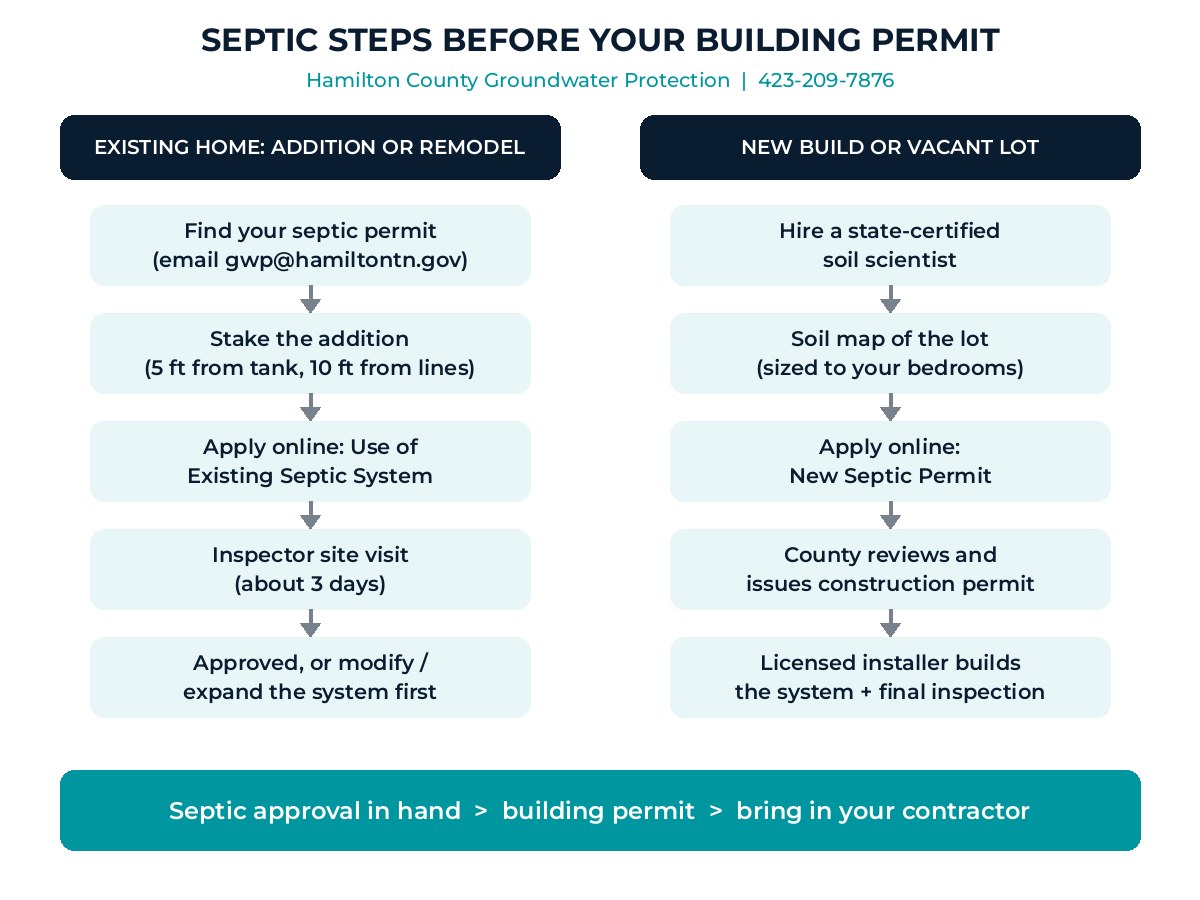
- Find your septic records. Email gwp@hamiltontn.gov for a copy of your existing septic permit or Certificate of Completion. It shows how many bedrooms your system was built for and roughly where it is.
- Know your numbers. Note your current bedrooms, planned bedrooms and the addition’s rough size.
- Stake out the addition. Mark the corners in the yard. Additions must be at least 5 feet from the septic tank and 10 feet from the field lines. Pools or additions that cut the grade more than a foot need 25 feet from the field lines.
- Apply online for an existing system review. In the county portal, choose “Existing Permit” or “Use of Existing Septic System” for non-bedroom space. Choose “Modification” if you’re adding bedrooms or field lines. The existing system review is $200 per site plus a $5 admin fee,, with a rough site sketch. The county may also ask for a soils map.
- Meet the inspector. An inspector usually visits within about three days.
- Get your answer. You’ll get an approval, a list of small changes, or a requirement to expand the system first. Denials can be appealed to the state as a variance request.
Step by Step: Building a New Home or Detached Unit
- Hire a soil scientist first. Before you design anything, a state-certified soil scientist maps the lot’s soils.
- Size the home to the soil. The soil map shows where a system fits and how many bedrooms the lot can support. Finish this before final house plans.
- Apply for a new septic permit. Submit a “New Septic Permit” application online with the soil map and site plan. Under Tennessee law, a certified soil scientist can also submit the full permit package for you on systems under 750 gallons per day.
- Get the construction permit. After the county approves the design, you get a permit to construct the system.
- Install and final inspection. A county-licensed septic installer builds the system, and it gets a final inspection and Certificate of Completion.
Soil Consultants Serving Hamilton County
Here are a few state-approved soil consultants who work in the Hamilton County area. Before you hire anyone, confirm they’re on the TDEC approved soil consultant list.
- Tennessee Soil Science (Cookeville): 615-894-4444, tennesseesoilscience.com
- David Myers Soil Consultants (Cleveland): 423-559-8122, davidmyerssoilconsultants.com
- Baxter Soil Consulting, William T. Baxter (Jasper): 423-942-6785
Tips That Save Time
- Call before you design. A five-minute call to 423-209-7876 can tell you whether your plan is likely to need a system upgrade.
- Don’t build over the system. Driveways, patios, decks and additions all need to stay clear of the tank and field lines, including the reserve area.
- Count bonus rooms honestly. A home office or “bonus room” with a closet may be treated as a bedroom. Ask the inspector how they’ll count it.
For the rest of the permit process, see our permits, codes and inspections guide and our Chattanooga ADU permit checklist. If you’re planning a lower-level suite, our guides to basement finishing costs and mother-in-law suites vs. backyard ADUs.

Septic Cleared? Let’s Build.
Once Groundwater Protection signs off, Peaceful Haven Homes handles the building permit, design and construction for additions, basement suites and remodels across Chattanooga, Signal Mountain, Lookout Mountain and the rest of Hamilton County. Call us at 423-777-6849 or contact us here.